
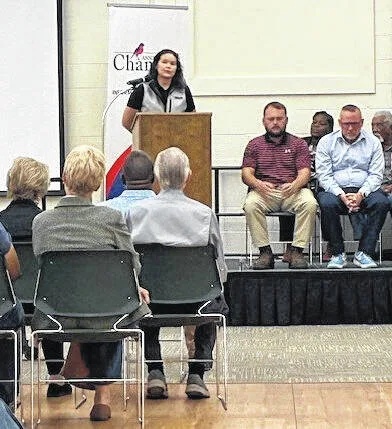
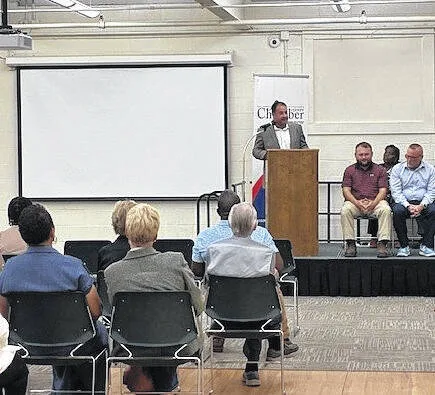
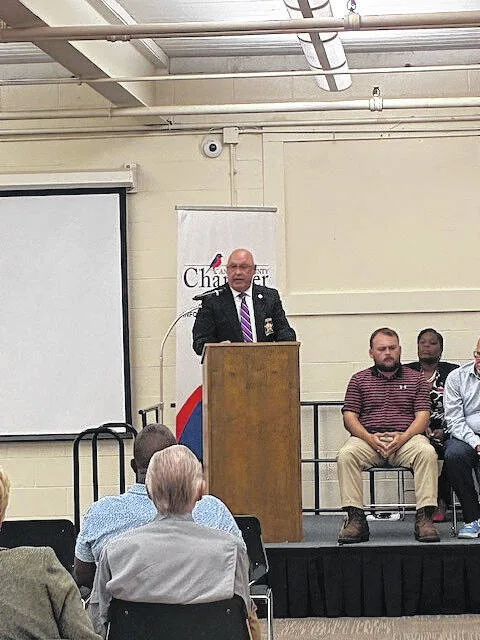
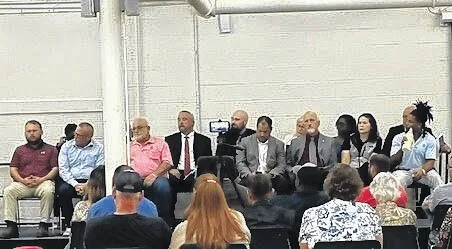
ANSON COUNTY — Taxes, economic growth and the long-running question of why so many of Anson County’s young people leave and never come back dominated the conversation at this year’s Politics After Dark, the annual candidate forum where residents hear directly from their constituents. Hosted annually by the Anson County Chamber of Commerce, Sam Cole, vice chair of the Anson County Chamber of Commerce, moderated the forum.
Candidates for county commissioner, school board, soil and water conservation, clerk of superior court, sheriff, district attorney and the U.S. House of Representatives were all presented with and answered the same questions.
“The number one thing is… our tax rate”
When asked how Anson County can attract new business while supporting the businesses it already has, Commission Chairman Jamie Caudle, who is running unopposed, answered without hesitation. He said, “The number one thing when it comes to recruiting industry is our tax rate. That is the cost to do business for an industry when they’re looking to locate.”
Caudle credited a tax incentive program created under his leadership, tiered by dollars invested and jobs created, with bringing in “$45 million in investments to Anson County” and 98 new jobs during his four years on the commissioner board. However, he cautioned that the county is not working together as it should and warned that recruitment will stall without investment in utilities.
“There ain’t no company coming here if they don’t have water,” he said. “If they don’t have running water and sewer, they’re not coming here, I promise you,” he reiterated.
Also troubling, the chairman pointed to a recent loss for the county, describing a $40 million company that had planned to locate in the county. “It was a done deal,” Caudle said. “The deal fell apart, 3 months later it was announced in a neighboring county.” He called the episode proof that “it takes all of us working together to make economic development a success in this county.”
William “Boogie” Short, a candidate for the district 2 commissioner seat, also focused on taxes. He reminded the audience that some officials have sought an 11% tax increase during the budget process.
“Industries consider taxes,” Short said. “They’re watching what commissioners are raising their hand to vote for that 11%.” He called for a line-by-line budget review instead of “adopting the same budget year after year after year,” and for a revenue-neutral rate after revaluation.
“I’m very conservative and I want to look out for the people’s money,” Short explained, adding, “Raising taxes deters industries and comes out of everybody else’s pocket.”
Sitting Union County Commissioner Clancy Baucom, who is running for NC House of Representatives District 55, said his board cut Union county’s tax rate from 58.8 to 43.42 cents per $100 after property values rose significantly. He urged Anson County to focus on safety, schools and dependable water, power and sewer. Baucom also pushed back on a familiar complaint. “Anson County is often called the middle of nowhere,” he said, but “it’s not actually, it’s in the middle of everywhere when you think of it.”
Other candidates tied economic growth to their own areas of focus.
Incumbent Sheriff Scott Howell stressed strong law enforcement builds solid infrastructure, supports local businesses and leads to steady community growth, while District Attorney candidates Jamie Adams and Todd Scott both pointed to public safety.
Clerk of Superior Court candidate Katie Scarborough noted that prospective businesses look at the county’s social media and urged residents to speak positively online. She also suggested having a government that works for its people, with an open-door policy that fosters a sense of shared destiny between residents and their elected officials.
U.S. House candidate Bo Whitehead called for fairer rules and lighter tax burdens for small businesses. School board candidates and District 5 commissioner hopefuls Kevin Adams and Robbie Hill linked recruitment to better schools, trade training, recreation and a more unified community.
Write-in candidate for district two of the school board, Charles Holley Jr. said, “Economic development coincides with the schools.” He continued, “Anson County is only going to work when we all get on the same page.”
Retaining Anson County Youth
The question of what Anson County can do to retain its youth proved a deeply personal one for many of the candidates.
“I have two older sisters who went off to college in the 1980s and never came back,” Short said. “Why? Because there was nothing here then.” He argued that the answer starts with commissioners who fund schools and law enforcement responsibly: “To keep them here, we have to have jobs.” He also proposed work-study partnerships between local industries and high schools that would let students earn credit while training on the job.
Caudle took aim at the idea that every student needs a college diploma. “You don’t have to have a 4-year degree to succeed in life, I promise you,” he said, pointing to welders, plumbers and electricians. “Every one of us in this room, we’ve needed a plumber in our life.” He described himself as “a firm believer in school choice” and a supporter of public schools. He said the long-term answer to housing costs is better-paying jobs, not cheaper houses: “recruit better jobs that pay more wages and then you can afford a better home.”
Lorri Burns Bennett, an at-large Board of Education candidate, framed the issue around schools and what graduates find when they return home. “Our kids go off to college, but what do they come back to?” she asked. She called for career and technical education, apprenticeships and stronger ties between schools and local employers. She said families need to trust that teachers “are there to help them and not just for a paycheck.”
Scarborough, a lifelong resident and current assistant clerk who left for college and law school before returning home, said her own story shaped her answer. “I could have gone anywhere to practice law, and I wanted to come back to Anson County,” she said. She pledged a clerk’s office people can depend on, noting that it “touches so many people’s lives during some of the most difficult moments.”
Bo Whitehead said he felt that federal tax dollars should come back to communities through school funding, trade schools, recreation and youth mental health services. “Teachers are basically saints. “They’re heroes,” he said, pledging to hold a quarterly meeting with representatives from every county in the district if elected.
Other candidates focused on families and accountability.
Sheriff Howell said he believes that continuing to invest in the safety of youth and families will attract new families to the area while simultaneously achieving youth retention. He said, “We need to start reaching our children at a younger age.”
Bennett shared that her vision for the county involves marrying economic opportunities with education. She said, “I want our students to graduate with meaningful opportunities.”
Union County commissioner and candidate for NC House of Representatives District 55, Clancy Baucom suggested that “Good schools and low taxes” are the reasons folks choose to move into Union County. He emphasized supporting law enforcement and education to incentivize similar population growth in Anson County.
Hill said he believes population retention starts with showing Anson youth they are loved and supported by their community. He also placed emphasis on having jobs available for young people to return home to.
Having built his career educating Anson County youth, Kevin Adams, who is a principal at Wadesboro Elementary School, said, “This is an issue near and dear to my heart… I can tell you why the number one reason that I am a democrat and it is because of what the most super majority in the Republican party has done to public education in our state.”
Brandon Smith, an at-large school board candidate, said the county’s strength is its people. He said, “We are investing in our kids. We are investing in our communities.” He told voters he has “an open mind” and is willing “to collaborate and work well with anyone.”
Competing visions for the district attorney’s office
The sharpest contrast of the night came in the three-county race for District 21 district attorney, which covers Anson, Scotland and Richmond counties.
Challenger Todd Scott, who said he made the area his home in 1996, argued that the office should stick to prosecution. “The short answer would be to keep this community safe,” he said. He took direct aim at programs promoted by District Attorney Jamie Adams, including a proposed RIDE (Restore Your Dignity Every Day) resource center. “I’m not criticizing Ms. Adams one bit for wanting to do those types of things,” Scott said. “What I am saying to you is that it is not the job of the district attorney.” Those services, he said, belong to the Department of Social Services.
Adams, a prosecutor for 18 years, defended her approach. “We’re not going to arrest and prosecute our way out of what we’re seeing in our communities,” she said. “But do not get me wrong, I will aggressively prosecute anyone who harms any citizen in Anson, Richmond, and Scotland Counties.” She described the RIDE center as a single, confidential place where residents could get help with mental health, literacy, utility bills and other needs without being singled out. She also noted that she is the only district attorney among the 20 members of the Governor’s gang prevention and intervention task force. “Safer homes equal safer communities,” she said.
What Anson County does well
When it comes to what is working in Anson County, many candidates pointed to its Agriculture.
“Anson County does really well in agriculture,” said Jesse Campbell, a Soil and Water Conservation Board candidate, citing the county’s poultry and cattle farms. “Agriculture is still a big, big business here in Anson County and North Carolina.”
Nicole Hatley Carpenter, who is running as a write-in candidate for Brown Creek Water Conservation District, emphasized leaning into the county’s foundation of agriculture. She said, “Agriculture is a big part of Anson County— we do really well at that.” She pointed out many residents still maintain chicken and turkey farms.
Chairman Caudle highlighted the timber industry, asking why the county has not turned it into more manufacturing. Returning to the $40 million company that got away, he noted, it was a timber manufacturer. “We recruited it and we lost it,” he said.
Across party lines and offices, a common theme emerged throughout the evening: Anson County’s leaders, they said, need to pull together and start moving in the same direction.